
Confronting anxiety can be daunting. An integral step in seeing change is challenging yourself without pushing yourself too far. Here, we will talk about three zones, which pertain to learning and behavioural change: the comfort zone, growth zone, and panic zone.
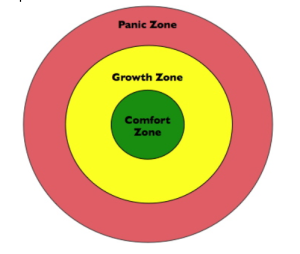
The comfort zone is the most well-known. It is the place most people like to be because it feels familiar, safe, and unchallenging. Activities that are routine for us would put us in the comfort zone. In fact, most activities in the comfort zone are automatic, requiring minimal cognitive effort (Van Gelderen, 2023). Playing a familiar song on an instrument you’ve been practicing for years, driving to and from work, or engaging in conversation with longtime friends are activities that would put most people in their comfort zones. Being in this zone is beneficial for our mental health and well-being: stress is low and we feel stable. However, learning and developing resilience do not happen here. In fact, staying in the comfort zone can lead to overreliance on familiarity and reduced openness to new experiences (Jeremiah et al., 2025). Research shows that learning occurs when we are placed in challenging and/or unfamiliar situations (Peters et al., 2012), which takes us to the next stage: the growth zone.
The growth zone is a state just outside of your comfort zone, where learning and change occur. In this zone, you may feel uncomfortable, but the discomfort is manageable and you still feel safe. In fact, research from over 100 years ago has shown that anxiety improves performance up to a certain point (Yerkes & Dodson, 1908). Examples of being in the growth zone could include learning a new language, driving for the first time, or presenting a new idea at work. Being in this zone helps you build adaptability and resilience. Oftentimes, we have mentors that help us through this stage, guiding us in practicing the activity and setting manageable goals. As a new activity is practiced, perceived competence rises and perceived risk and discomfort lowers (Van Gelderen, 2023). When an activity in the growth zone is practiced enough and stress levels lower, your comfort zone expands. From here, you are able to enter the growth zone again. However, when you try to jump into anxiety provoking new experiences too soon without proper support, the growth zone may be skipped entirely, and you instead enter the panic zone.

The panic zone is where you feel overwhelmed, on edge, and uncomfortable to a point that is unsustainable. For example, you would likely enter the panic zone if you were thrown into the deep end of the pool at your first swimming lesson, had to perform a song you’ve barely practiced in front of an examiner, or were forced to hold a spider despite experiencing arachnophobia. According to Yerkes and Dodson (1908), beyond the optimal level of arousal, performance declines as levels of anxiety increase. Due to the intense stress that occurs in this zone, people often immediately retreat back to the comfort zone for safety (Val Gelderen, 2023).
The goal in therapy is to facilitate exercises/activities that encourage clients to leave the comfort zone and enter the growth zone, without being so overwhelming that they fall into the panic zone. A client’s response can be gauged using the Subjective Units of Distress Scale (SUDS), which has clients rate their level of anxiety and/or distress in response to a particular situation or stimuli on a scale from 0 to 100 (Benito et al., 2025).
Exposing yourself to safe but anxiety provoking situations is key to building resilience. However, it is important that you feel supported along the way too in order to positively respond to exposure (Fletcher & Sarkar, 2016). Exposure is a key component of Cognitive Behavioural Therapy (CBT) for anxiety disorders, trauma related disorders and OCD (Benito et al., 2025). In vivo exposure involves repeated confrontation of feared situations/stimuli without engaging in safety behaviours. When completing exposure therapy, working within the growth zone is a key consideration. One way this is accomplished is by making SUDS ratings for different exposure goals to ensure the exercise you are working on moves you into the growth zone without going too far too fast. For example, if you are addressing a fear of contamination, you might work with your therapist to identify several related activities and make a SUDS rating for each:
- Touching a door handle in your house without washing your hands after – SUDS = 35
- Touching a doorknob in your friend’s home without washing your hands after – SUDS = 50
- Touching a door handle at the mall without washing your hands after – SUDS = 80
You then organize these items into an exposure hierarchy that includes roughly ten to fifteen items that span a wide range of SUDS ratings. You start by practicing the situation that evokes a low to moderate SUDS (e.g., situation 1 above). After building confidence in your ability to cope with this situation through repeated practice, you progress up your hierarchy. Ideally, each situation you are working through is within the growth zone: not too comfortable, but not exceedingly overwhelming.
As another example, let’s say you are working through a fear of driving. Some items on your hierarchy might look like this:
- Drive on a road with an 80 km/hour speed limit when it is not busy – SUDS = 40
- Drive on a road with an 80 km/hour speed limit during rush hour – SUDS = 50
- Drive on a four-lane highway at a time of day when it is not busy – SUDS = 65
- Drive on a four-lane highway during rush hour – SUDS = 85
The key is to continue to practice the situation until you build your confidence and your SUDS level comes down. Then, you can take a step up and try a more challenging variation of the situation. All in all, the key is to use a gradual approach so you can build confidence while also stepping out of your comfort zone.
Sometimes, we may underestimate our SUDS for certain situations. For example, let’s say you are challenging your fear of spiders. When initially asked to provide a SUDS for viewing a spider in an enclosure at close proximity, you might rate it as a 40. Then, when you find yourself stepping closer to the enclosure, you feel more anxious than you thought… you realize your SUDS is more like an 80 and you are going to be in the panic zone. It’s important not to escape from the situation or quit the exposure practice because doing so will strengthen the anxiety and avoidance behaviours. Instead, you want to use a backup plan. Maybe instead of viewing the spider up close, you view it from a few feet away. This makes the goal feel more manageable, but you are still challenging yourself. Predicting whether a goal will put you in the growth zone or the panic zone can sometimes be difficult, especially when first starting exposure exercises – this is why your therapist will help you make a backup plan at the same time you design your exposure.
Treating anxiety often involves approaching rather than avoiding your fears, so you can learn to cope with them (Greenberger & Padesky, 2015). Behavioural experiments (BE) are another common CBT tool that encourages you to move into the growth zone. BEs are planned experiential activities that test the validity of the beliefs you hold about yourself, others, and/or the world around you (Bennett-Levy et al., 2004). Let’s say you experience anxiety in social situations and feel uneasy around groups of people, especially when you don’t know them. Because of this, you have developed a habit of avoiding groups of people when you are out. Here is a step-by-step guide to conducting a BE using this as an example:
1)State the negative belief and how strongly you believe this belief from 0-100
“When I walk by a group of people, they will stare at me or start talking about me.” (80)
2)State an alternative prediction and how strongly you believe this prediction from 0-100
“When I walk by a group of people, they may continue their conversation or say hello to me.” (20)
3)Design a behavioural experiment to test your predictions
“It’s supposed to be a nice and sunny day on Saturday. I’ll go to the public park near my house where lots of people gather with their friends and family. I will try to walk past 5-10 groups of people.”
4)State the problems you may experience and how you will handle them
“I may walk past a group of people that stare at me as I walk by. In this situation, I will take a deep breath and continue walking. I will avoid fleeing the situation and going home immediately if this happens. My goal is to walk past at least one more group of people if this occurs.
If Saturday comes and the weather is lousy, I will complete the experiment at the mall instead.”
5)Document how the experiment unfolded, including evidence for and against the predictions, and what you learned
“I walked by eight groups of people when I went to the park on Saturday. Five groups continued talking to each other and didn’t pay any attention to me, two groups waved hello, and one group looked at me as I walked by. In total, only one of the eight groups reacted in a way that I was afraid of, but I got through it. I challenged myself to walk by one more group of people after this interaction, to prove to myself that I can still function and do difficult things even when my anxiety level increases.”
6)Re-rate how strongly you believe the original belief and the alternative prediction
“When I walk by a group of people, they will stare at me or start talking about me.” (20)
“When I walk by a group of people, they may continue their conversation or say hello to me.” (80)
BEs are important interventions, because people are unlikely to overcome their anxiety unless they change their thought patterns and disrupt avoidance behaviours (Greenberger & Padesky, 2015). As seen in step 2, this technique also helps you come up with healthier alternative beliefs that are more realistic (Dryden, 2015). The more BEs are practiced, the more automatic this process becomes. Similar to exposure, BEs are designed to move you into the growth zone, but are not intended to be so challenging that you enter the panic zone. As your beliefs start to shift and you build confidence, you can design a BE for a more challenging situation that pertains to your goals.
In conclusion, exposure and BEs are extremely helpful techniques in overcoming anxiety, OCD, trauma, and phobias. If you are struggling with anxiety and avoidance behaviours, the registered psychologists and psychotherapists at the Waterloo CBT Clinic are available to help. Reaching out is the first step to improving your mental well-being.
Authors: Ella Crawford B.Sc. (Hons) and Dr. Erin Fallis, C.Psych.
References
- Benito, K., Pittig, A., Abramowitz, J., Arch, J. J., Chavira, D., de Kleine, R., De Nadai, A. S., Hermans, D., Hofmann, S. G., Hoyer, J., Huppert, J. D., Kircanski, K., McEvoy, P. M., Meyer, H., Monfils, M.-H., Papini, S., Rief, W., Rosenfield, D., Storch, E. A., … Smits, J. A. (2024). Mechanisms of change in exposure therapy for anxiety and related disorders: A research agenda. Clinical Psychological Science, 13(4), 687–719. https://doi.org/10.1177/21677026241240727
- Bennett–Levy, J., Westbrook, D., Fennell, M., Cooper, M., Rouf, K., & Hackmann, A. (2004). Behavioural experiments: Historical and conceptual underpinnings. Oxford Guide to Behavioural Experiments in Cognitive Therapy, 1–20. https://doi.org/10.1093/med:psych/9780198529163.003.0001
- Dryden, W. (2015). How to Get the Most Out of CBT: A client’s guide (1st ed.). Routledge.
- Fletcher, D., & Sarkar, M. (2016). Mental fortitude training: An evidence-based approach to developing psychological resilience for sustained success. Journal of Sport Psychology in Action, 7(3), 135–157. https://doi.org/10.1080/21520704.2016.1255496
- Greenberger, D., & Padesky, C. A. (2015). Mind Over Mood: Change How You Feel by Changing the Way You Think (2nd ed.). Guilford Press.
- Jeremiah, F., Butson, R., & Oke, A. (2025). New Perspectives on repetitive behaviour. Psychological Research, 89(2). https://doi.org/10.1007/s00426-025-02092-6
- Peters, V., van de Westelaken, M., & Bruining, J. (2012). Simulation Games as a Safe Environment: What can Game Designers and Facilitators do to Guard the Psychological Security of Participants? Studies in Simulation and Gaming, 22(Special), 59–64. https://doi.org/ https://doi.org/10.32165/jasag.22.SPECIAL_59
- Yerkes, R. M., & Dodson, J. D. (1908). The relation of strength of stimulus to rapidity of habit‐formation. Journal of Comparative Neurology and Psychology, 18(5), 459–482. https://doi.org/10.1002/cne.920180503
- Van Gelderen, M. (2023). Using a comfort zone model and daily life situations to develop entrepreneurial competencies and an entrepreneurial mindset. Frontiers in Psychology, 14. https://doi.org/10.3389/fpsyg.2023.1136707