Procrastination: What It Is, Why It Happens, and How You Can Fix It
With the school year beginning and activities coming back into full swing, one habit tends to loom undetected until it becomes a nuisance: procrastination. Whether it’s cramming the night before an exam, submitting a paper at exactly 11:59, pushing errands or postponing payments until the very last minute, we have all procrastinated at some point in our lives.
 Most of us know how procrastination feels and affects us, but what exactly is procrastination? Simply put, procrastination is the “voluntary and unnecessary delay in the start or completion of important and intended tasks despite recognizing there will be harmful consequences for oneself and others for doing so” (Sirios & Pychyl, 2013). Procrastination is not laziness or an issue with time management. Although these issues may seem closely intertwined, procrastination is much more of an emotion regulation problem (Pychyl, 2019). An important yet often overlooked aspect of procrastination is captured in its definition: the idea that we know in advance there will be negative consequences of procrastinating and yet we do it anyway. This brings up another intriguing question: why do we continue to procrastinate even when we know it isn’t good for us?
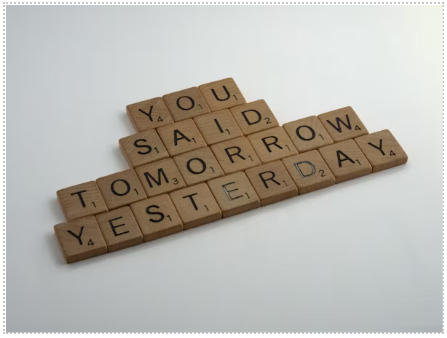
There are a couple of common reasons for this; one is short-term gratification. Oftentimes, procrastination occurs because we are prioritizing short-term gratification and mood regulation over long-term goals. As animals, we naturally want to avoid aversive and under stimulating tasks and instead shift towards positive and pleasurable ones (Sirios & Pychyl, 2013). In many situations, we can exert the self-control necessary to complete tasks despite the negative mood they elicit. However, procrastination by definition is the lack of this self-control. Another common reason for procrastination involves the “promise of tomorrow” (Pychyl, 2012). Most of us are very familiar with the phrase “I’ll do it tomorrow,” which is probably the most popular verbal manifestation of procrastination. We often tell ourselves that we will “feel more like it tomorrow.” Then tomorrow comes, and we still don’t feel like it. This becomes a vicious cycle until the task truly needs to be done, resulting in a state of panic and adrenaline (Pychyl, 2012). After the task gets completed in this rushed state, we focus more on the fact that the task was finished rather than reflecting on how much time we wasted by pushing things off. So the next time a task comes up, we use this same counterintuitive strategy.
As with breaking any other habit, much of what we can do to combat procrastination is easier said than done. To help combat your procrastination, it is important to identify your procrastination “triggers.” According to Le Cunff (2021) procrastination results when you anticipate a task will be boring, frustrating, difficult, or stressful. Other triggers can make an appearance as you start working on a task, such as lack of structure, meaning, rewards, or ambiguity. The good thing is, there are several ways to manage these triggers. Identifying the main trigger is the first step to addressing the problem. After this step, you can utilize several techniques to manage your procrastination based on what will resolve the trigger most effectively.
Here are some strategies that can be useful in addressing procrastination:
- Filter tasks based on urgency
Oftentimes, procrastination occurs because we are unsure of how to start. Take studying for a test as an example. Which unit do you begin with? Are there certain concepts that are more likely to be tested than others? What is the best study strategy to use? How long should I study for? These are just a few questions that may pop into your mind. A technique that can be helpful is categorizing each “step” of the process as either urgent or non-urgent. Let’s take the first question as an example. You can start by looking through the units/concepts being tested, and essentially rank your level of understanding for each. It would be more “urgent” to start with the content you know less well. When using this strategy, try to only focus on urgent/more pertinent tasks for the time you are in a procrastinative state. This can help you overcome your procrastination. - Utilize the 10 minute rule
Thinking about a task that will likely take several hours feels much more manageable when you break it down into smaller chunks. Oftentimes the hardest part of a task is getting started. Once you get over that initial step, continuing the task often feels much easier. When attempting to start a task you are dreading, mentally tell yourself “I’ll do this for 10 minutes. Then I will see how I feel.” There is a high likelihood that you will continue the task past these 10 initial minutes. The basic reasoning is this: it tends to be a lot harder to get started on something than to keep going (Le Cunff, 2020). Additionally, it shifts your focus to a more manageable goal. - Tap into the Premack Principle
This is one of the most creative and widely used ways of combatting procrastination triggers. The Premack Principle states that more preferable activities or behaviours reinforce less favourable activities or behaviours (Rozental and Carlbring, 2014). Think of the task you are dreading, and pair it with something enjoyable. The most common example is rewarding yourself with a sweet treat after doing an unrewarding task. If you are dreading cleaning out your closet because it’s boring, play your favourite music in the background to make it more fun. If you are working through a difficult homework set, ask a classmate or friend if they can help you. The possibilities are endless. - Consider the next action
This is similar to chunking, but more strategic. You can use this strategy even before you start the task you are dreading. This involves merely thinking about the next action, similar to method acting (Pychyl, 2016). Ask yourself “If I were to do this task, what’s the next action I’d take?” For example, after coming home from work and dreading the house cleaning you have to do, think about how you would first open the cleaning supplies closet. Then you would grab the duster, broom, and the mop. Then you would choose a room to start with. You get the idea. Merely thinking through the steps can help reduce the distress associated with the task. Once you have tried this for a few minutes, start taking those thoughts and acting on them, then continue using this strategy. When your mind wanders off or you start thinking about how much you’d rather not do the task, catch these thoughts, and again ask yourself: “what’s the next action?” (Pychyl, 2016). It can be difficult catching unhelpful thoughts as they come at first, but the more you practice this technique, the easier it becomes. - Don’t wait until you feel motivated
A common misconception is that we need to feel motivated to get started on a task. Because of this, we often wait around for motivation to strike, but unfortunately motivation rarely shows up on its own. In reality, motivation follows action. If you sit around waiting to feel inspired, you’ll probably stay stuck; but if you act first, the motivation you were hoping for will usually follow.
For some, procrastination is a fleeting behaviour, but for others it is a debilitating issue that affects many aspects of their everyday life. Although most of us can relate to the tendency to procrastinate occasionally, procrastination can also occur due to an underlying mental health concern such as depression, anxiety, perfectionism, or ADHD (Oguchi et al., 2021). The most common approach to addressing procrastination is cognitive behavioural therapy (CBT; CBT Los Angeles, 2020). CBT for procrastination involves identifying causes of the procrastination, changing thinking patterns, and implementing new strategies and positive coping skills. If you or a loved one is struggling with procrastination, registered mental health professionals are available to help.
Authors: Ella Crawford B.Sc. (Hons) and Dr. Erin Fallis, C.Psych.
References
- Burns, D. (2018). 075: Five Simple Ways to Boost Your Happiness–#2: Do Something You’ve Been Putting Off. https://feelinggood.com/2018/02/12/075-the-second-simple-way-to-boost-your-happiness-do-something-youve-been-putting-off/
- Cognitive Behavioral Therapy Los Angeles. (2020). Cognitive behavioral therapy (CBT) exercises to overcome procrastination. https://cogbtherapy.com/procrastination-los-angeles
- Cunff, A.-L. L. (2020, May 5). The ten minute rule of productivity. Ness Labs. https://nesslabs.com/ten-minute-rule
- Cunff, A.-L. L. (2021, June 10). Procrastination triggers: Eight reasons why you procrastinate. Ness Labs. https://nesslabs.com/procrastination-triggers
- Oguchi, M., Takahashi, T., Nitta, Y., & Kumano, H. (2021). The moderating effect of attention-deficit hyperactivity disorder symptoms on the relationship between procrastination and internalizing symptoms in the general adult population. Frontiers in Psychology, 12. https://doi.org/10.3389/fpsyg.2021.708579
- Pychyl, T. (2012). I’ll feel more like it Tomorrow. Psychology Today. https://www.psychologytoday.com/ca/blog/dont-delay/201203/ill-feel-more-it-tomorrow